
McLaren boss Andrea Stella believes the “element of variability” of F1’s largely untested power units in the wet is “concerning” ahead of a potentially wet Canadian GP.
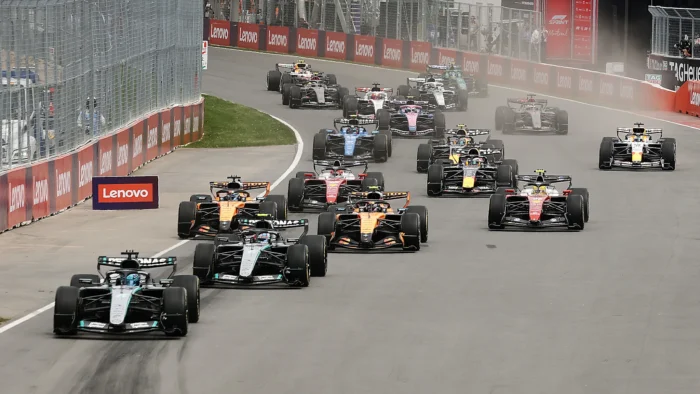
The Montreal race is expected to be wet, which poses a problem for grand prix teams as only a handful have completed any running in such conditions with the new 2026-spec power units.
With the need to be smooth and consistent with driving style and power input to extract the best from the complex new designs, only a handful of teams and drivers, including Lewis Hamilton and Ferrari, have any experience of running in the wet, doing so in a Pirelli wet-weather test at Fiorano in April.
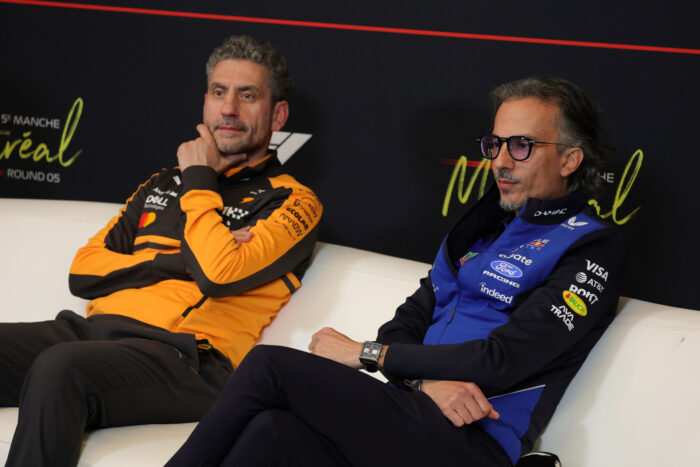
Stella’s McLaren operation has no experience of running in the wet during the 2026 season, with the Italian detailing just how tricky the race could be.
“In terms of the wet session, there are a few teams that have had the possibility to test and drive in wet conditions,” Stella observed to media, including ApexF1.
“I do think that this is an advantage, because there is uncertainty in relation to the behaviour of the power unit.
“We see that talk pretty much in every debrief in dry conditions after a few events, and we talk about power unit exploitation, and in the wet, things deviate even more from what you anticipate and what you can simulate.
“So the power unit remains certainly an element of variability that is concerning, and if you have tested with it [in wet conditions], you might know a little bit more. Likewise, from a tyre point of view, it is unclear whether the tyres will work within the window or if they will be slightly outside.
“I am talking about the temperature window because this circuit doesn’t have any high-speed corners, so it is difficult to generate temperature, and the surface is very smooth; it is one of the smoothest of the season.
“Therefore, it is difficult to generate temperature, and it is not like we have had several sessions during the race weekend for Pirelli to calibrate.
“There are so many variables for us to discover as we don’t have much experience in the wet, and there is a little advantage for those who have tested.”